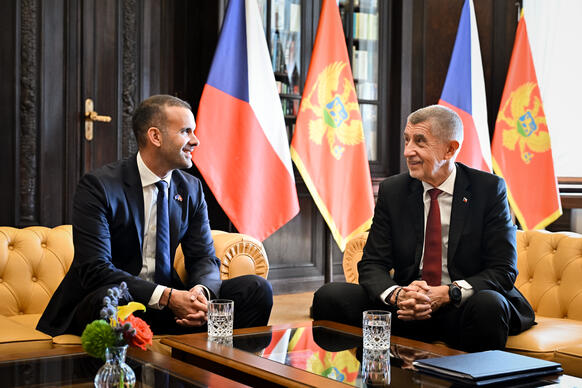
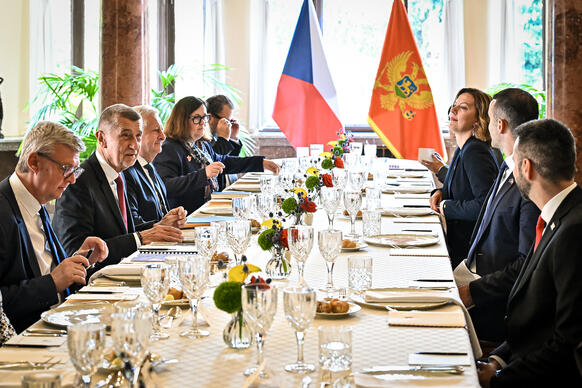
Prime Minister Babiš received the Prime Minister of Montenegro, Milojko Spajić; they discussed the country’s European integration and defence cooperat

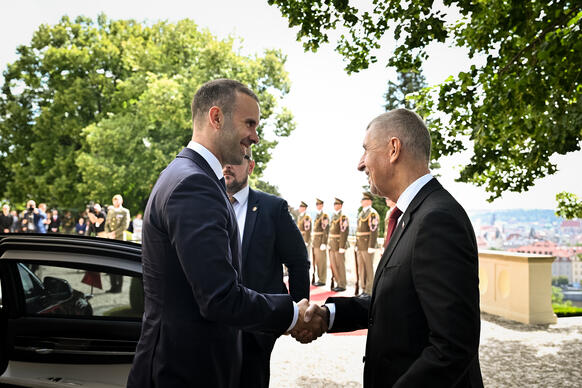
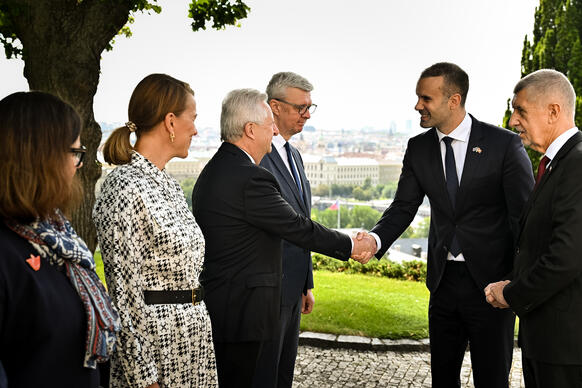
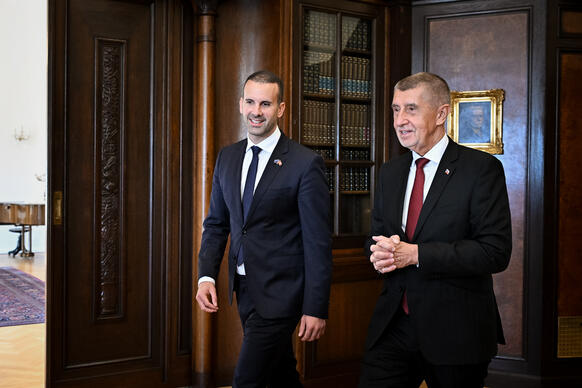
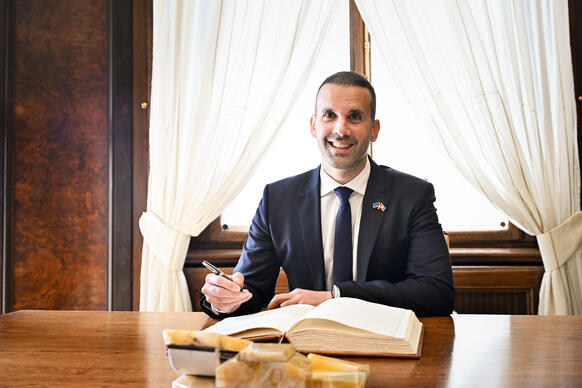
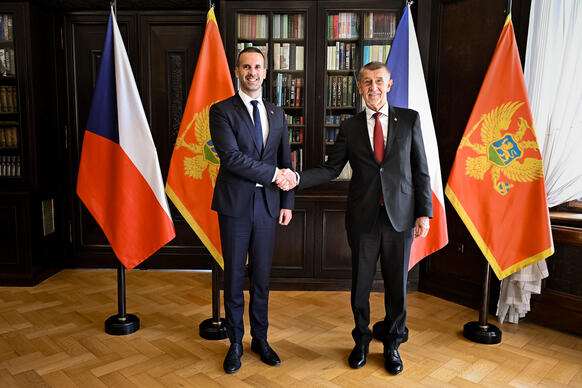
Předseda vlády ČR Andrej Babiš přijal v pátek 24. července 2026 v Kramářově vile předsedu vlády Černé Hory Milojka Spajiće. Společně s prvním místopředsedou vlády a ministrem průmyslu a obchodu Karlem Havlíčkem a místopředsedou vlády a ministrem obrany Jaromírem Zůnou jednali o pokračování integračního procesu Černé Hory směrem k členství v Evropské unii, rozvoji obranné spolupráce a obchodních příležitostech mezi oběma zeměmi.
The prime ministers followed on from their previous talks in Davos and at the EU–Western Balkans summit in Tivat. This year marked their third meeting, which underscores the intensity of the Czech-Montenegrin dialogue and their shared interest in further developing their cooperation.
“I am pleased that today we can build on our discussions and further develop Czech-Montenegrin relations. Montenegro is a popular holiday destination for Czech citizens and, at the same time, a country where a number of Czech companies operate successfully. Our relations have a very solid foundation for further development,” said the Prime Minister.
Prime Minister Babiš welcomed Montenegro’s decision to establish a resident embassy in Prague. “It’s great that the Prime Minister has decided to establish a resident embassy of Montenegro in Prague by the end of the year. This means that both countries are keen to further strengthen their mutual cooperation and develop our partnership in the political, economic and institutional spheres,” said Prime Minister Babiš.
The main topic of the meeting was Montenegro’s European integration. The Czech Republic has long supported the enlargement of the European Union to include the countries of the Western Balkans and regards Montenegro as one of the best-prepared candidates for membership.
“We stand by Montenegro and support its accession to the European Union. It is ideally positioned for it. It is already part of the eurozone, talks are progressing very promisingly, and I firmly hope that Montenegro will become the 28th EU member state in 2028,” emphasised Prime Minister Babiš.
Montenegro offers a range of opportunities for Czech companies, particularly in the energy, transport, healthcare and defence sectors. The prime ministers discussed ways of further developing economic cooperation, the involvement of Czech companies in EU funded projects, and support for mutual investment and trade between the two countries.
“We regard Montenegro as an important partner with great potential. Today’s meeting was very focused, positive and pragmatic. I am very pleased that our relations are developing dynamically. We have agreed with Prime Minister Spajić on further plans regarding when the Czech-Montenegrin Committee for Economic Cooperation should meet,” added Prime Minister Babiš.
Defence cooperation was also a key topic at the meeting. The prime ministers welcomed the signing of the Implementation Agreement on cooperation in the field of armaments and military equipment between the Ministry of Defence of the Czech Republic and the Ministry of Defence of Montenegro. Under the Agreement, Montenegro’s armed forces will be modernised using Czech defence equipment.
"I am very pleased that the Prime Minister visited us today. We met on 5 June 2026 in Tivat at a meeting between EU countries and the countries of the Western Balkans, and our cooperation has now taken on a very concrete form. Our Ministries of Defence have signed an Implementation Agreement on cooperation in the field of armaments and military equipment. We are NATO allies with Montenegro, so we have a shared interest in investing in security. I am pleased that we were able to sign this major contract for the supply of several thousand Czech-made weapons and rounds of ammunition, worth 24.2 million euros. This is the first important step, which paves the way for further new joint projects,” emphasised Prime Minister Babiš.