Prime Minister Andrej Babiš held talks with the President of the European Council, António Costa, on the next EU budget
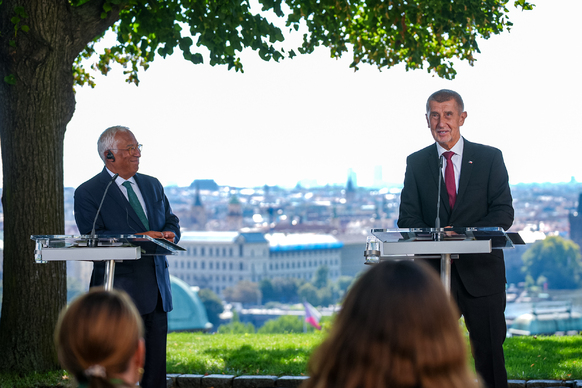
On Thursday 27 August 2026, Prime Minister Andrej Babiš received the President of the European Council, António Costa, at Kramář Villa. They discussed, in particular, the shape of the European Union’s new multiannual financial framework and the priorities the Czech Republic is advocating in the negotiations on the new EU budget, as well as the EU’s further enlargement to include the countries of the Western Balkans.
The President of the European Council, António Costa, visited Prague as part of his tour of EU Member States, during which he is gauging the views of their leaders on the forthcoming new EU multiannual financial framework. Following talks at Kramář Villa, Prime Minister Andrej Babiš commended the European Council President’s interest in the Czech Republic’s key priorities in the negotiations on the new EU budget.
“I am very pleased that António Costa visited us and that we had the opportunity to discuss our views on the European Union's key priorities for two hours. I believe that since our government took office, it has been proactive and has put forward proposals that address the European Union’s competitiveness. “I am referring primarily to the ETS I allowances as the energy sector and energy prices are crucial to competitiveness,” said the Czech Prime Minister.
The key topic of talks with the European Council President was the upcoming EU multiannual budget, which António Costa aims to negotiate by the end of the year. “Naturally, it is essential for us that the Czech Republic secures the best possible outcome in the negotiations. I told the President that, in our view, the cuts to the Cohesion and Agricultural Funds proposed by the European Commission are not acceptable to us. While we naturally support funding for defense or technology investments, this must not come at the expense of our regions," Prime Minister Andrej Babiš stated.
According to Prime Minister Babiš, the next EU budget must not worsen the position of weaker economies and industrialised countries. “Member States must be treated equally, and the budget must ensure balance across the European Union,” Prime Minister Babiš emphasised. “Naturally, it is important that centrally managed programs aimed at boosting competitiveness benefit everyone, not just the richest and largest countries," he added.
High energy prices are a major problem for the economy. The European Commission presented a proposal in July to revise the ETS emissions trading system, partly as a result of pressure from the Czech government; however, these efforts must continue to relieve energy-intensive industries so that high allowance prices do not drive them to relocate outside the EU. “We also find the proposal for the distribution of revenue from emission allowances unacceptable. We want the proceeds to remain in the hands of member states, which know best how to invest them," stated Prime Minister Babiš.
Other topics on the agenda included the possible enlargement of the European Union to include additional member states, specifically the countries of the Western Balkans. The Czech Republic supports the enlargement, provided that the candidate countries fulfil all the stipulated conditions. At the meeting, Prime Minister Babiš recalled that the countries of the Western Balkans have made fundamental progress in this regard and that, for example, Montenegro and Albania have been waiting a long time for the approval of their accession, even though they are very close to membership. The integration of these countries into the EU and their incorporation into the Schengen area are in the strategic interest of the Czech Republic.